

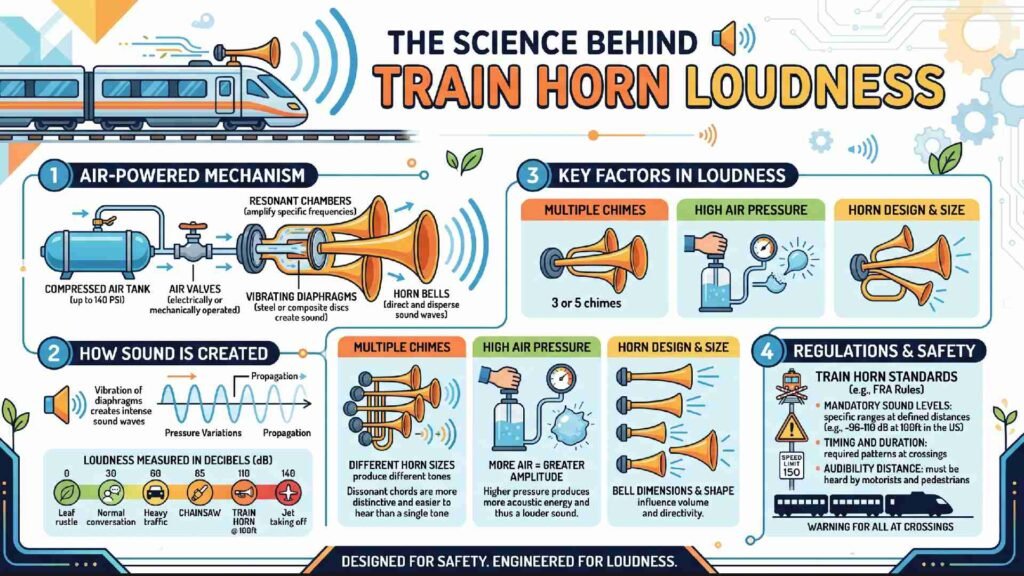
When a train horn blasts at 150+ decibels, it’s not luck, it’s engineering. The power of a horn’s sound depends on air pressure, airflow, materials, and internal resonance. In this guide, we break down the exact science behind what makes a train horn truly loud, and why USA‑made horns deliver a deeper, fuller, more authoritative tone.
What Makes a Train Horn Loud? The Physics Behind the Roar
A train horn produces sound when compressed air forces a metal diaphragm to vibrate. That vibration travels through the horn’s body, amplifying into massive sound waves.
The key factors that determine loudness include:
- Air pressure (PSI)
- Airflow volume (CFM)
- Horn material and resonance
- Horn length and internal geometry
- Manifold precision and sealing
When these elements work together, you get the unmistakable locomotive‑style blast.
PSI vs. CFM: Why Both Matter for Maximum Loudness
Many people assume PSI alone determines loudness — but that’s only half the story.
PSI (Pounds per Square Inch)
PSI is the force pushing the air through the diaphragm. Higher PSI = stronger vibration = louder initial blast.
CFM (Cubic Feet per Minute)
CFM is the volume of air delivered to the horn. Higher CFM = longer, fuller, more sustained sound.
The Perfect Combination
A loud horn requires high PSI + high CFM. If you only have PSI, the horn hits hard but dies quickly. If you only have CFM, the horn lasts long but sounds weak.
USA Train Horn’s RC Series is engineered to balance both, producing a massive, sustained roar.
Tank Size & Air Delivery: The Hidden Factor Most People Ignore
Your air tank determines how long your horn can maintain peak loudness.
Tank Size Comparison
- 1 gallon: Short bursts; ideal for cars.
- 2 gallons: Balanced performance for daily drivers.
- 5 gallons: Maximum output for trucks and semis.
A larger tank provides:
- More available airflow
- Less pressure drop
- Longer, more consistent blasts
- Reduced compressor strain
If you want the loudest possible performance, tank size matters more than most people think.
Material Matters: Cast Aluminum vs. Steel vs. Plastic
The horn’s material directly affects its resonance and tone.
Cast Aluminum (USA Train Horn Standard)
- Clean resonance
- Stable vibration
- Corrosion‑proof
- Deep, authentic sound
- Extreme durability
Steel
- Heavy
- Prone to rust
- Metallic, less controlled resonance
Plastic (ABS)
- Cheap
- Weak sound
- Low durability
- Not suitable for serious use
USA Train Horn uses hand‑poured cast aluminum, giving each horn a richer, fuller tone than imported steel or plastic horns.
Why USA‑Made Horns Sound Fuller & Deeper
The difference isn’t just the material — it’s the craftsmanship.
USA‑made horns feature:
- Precision‑machined manifolds
- Stainless steel hardware
- Calibrated internal chambers
- Premium powder‑coat finishes
- High‑tolerance diaphragms
This results in a sound that is deeper, cleaner, and more stable, unlike the thin, sharp tone of mass‑produced imported horns.
Recommended PSI Settings for Cars, Trucks & Semis
Cars (compact & sedans)
120–140 PSI Great for smaller kits and 1–2 gallon tanks.
Pickups & SUVs
140–150 PSI Ideal for RC Series horns and 2–5 gallon tanks.
Semis & Work Trucks
150 PSI+ Maximum power and sustained output.
Final Takeaway: Loudness Is Engineering, Not Luck
A truly loud train horn depends on:
- PSI
- CFM
- Tank size
- Material
- Resonance
- Precision manufacturing