

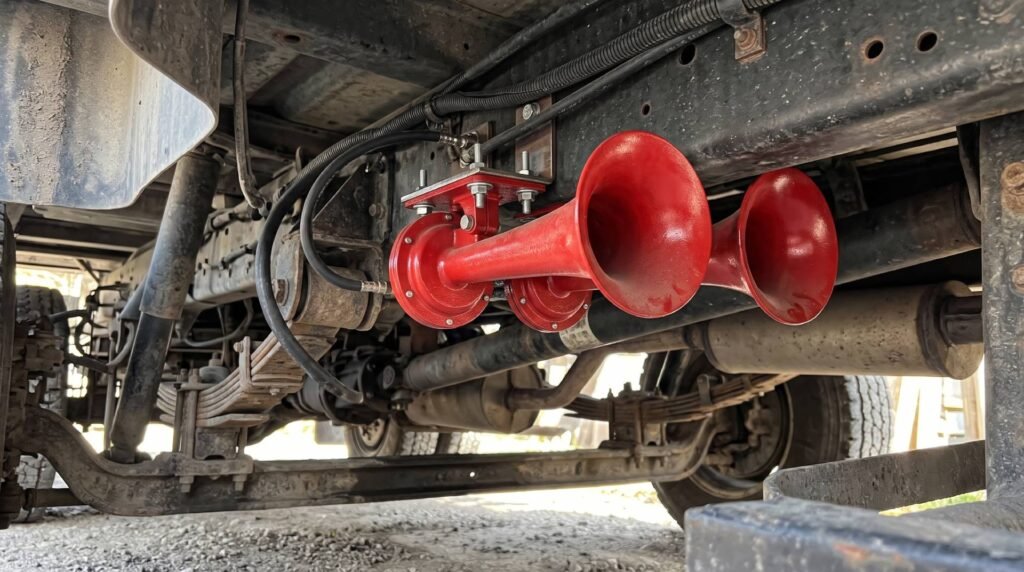
Quick answer: The best train horn for a truck is a fully cast aluminum air horn fed by an onboard compressor and air tank, built to survive heat, salt and vibration. At USA Train Horn, every horn is hand-cast, machined, inspected, powder coated and sound-tested in our own facility in Hialeah, Florida. Our RC series ranges from about 152 dB (3 trumpets) to above 160 dB (6 trumpets), and every horn carries a lifetime warranty against manufacturing defects.
A factory horn is made to warn the car next to you. A train horn for a truck is made to be heard over highway wind, diesel engines and distracted drivers. If you drive a semi, a work pickup or a lifted daily driver, this guide explains how truck train horns work, what “handmade in the USA” really means on our shop floor, and how to pick a kit that will still sound like day one in ten years.
Key facts at a glance
- Made in: Hialeah, Florida, USA, in-house
- Process: hand-cast aluminum horns and manifolds, billet aluminum machined lids, stainless steel hardware
- Finish: textured red or black powder coat
- Loudness: about 152 dB (RC3L) to above 160 dB (RC6)
- Warranty: lifetime, on horn function and manufacturing defects
- Complete kits: from $1,369.99 (Train Horn Kits)
What is a train horn for a truck, and how does it work?
A train horn for a truck is a pneumatic (air-powered) horn with two to six trumpets, modeled on locomotive horns and sized for pickups, semis and work trucks. Unlike a 12V electric horn, it uses compressed air to vibrate a metal diaphragm, and each trumpet amplifies that vibration into one note of a deep chord.
Every complete system has four parts:
- Compressor: fills the tank, typically to 150 to 200 PSI.
- Air tank: stores the air; 3 to 5 gallons is the sweet spot for trucks and semis.
- Solenoid valve and switch: releases the air into the horn when you press the button.
- Horn (trumpets + manifold): turns the airflow into sound.
Loudness depends on both pressure (PSI) and air volume (CFM). High PSI gives a hard initial blast; high CFM keeps the note full for longer. For the full physics, read The Science Behind Train Horn Loudness, and for a head-to-head with factory horns, see 12V Electric Horn vs. Real Train Horn.
Made in the USA, fully handmade: what that means in our shop
Every USA Train Horn is built start to finish under one roof in Hialeah, Florida, by one small team. Most horn kits sold online are assembled from parts made by different suppliers overseas; ours are not. Here is the six-step path every truck train horn takes before it ships:
- Hand-cast trumpets and manifold. Molten aluminum is poured by hand into each trumpet and manifold. Casting creates a thick, dense wall that produces a deeper tone than thin stamped or plastic bells.
- Hand processing and inspection. Each casting is cleaned and checked by hand. Parts that fail inspection never reach the next station.
- Billet-machined caps. The lids are machined from solid billet aluminum for a tight, leak-free seal that keeps pressure inside the horn.
- Assembly with stainless steel hardware. Each set is assembled one at a time, with hardware that resists rain, road salt and vibration.
- Individual sound test. Every unit is blown and tested on its own. If it does not sound right, it does not ship.
- Textured powder coat. A red or black textured powder coat (our Red Line and Black Line) seals the aluminum against sun, humidity and road debris.
Because we make every component ourselves, we can also replace any single component: a trumpet, a manifold, a valve or a fitting. You fix the part, not the whole kit. See the full walkthrough in From Hialeah to the Whole USA, and our comparison Handmade American-Made Train Horns vs. Imported Horns.
How durable is a handmade cast aluminum train horn?
A fully cast train horn is built to outlast the truck it is mounted on. Our horns are cast in 319-type aluminum, a heavy-duty casting alloy of roughly 90.5% aluminum, 6% silicon and 3.5% copper (eFunda). It is the same alloy family the auto industry uses for engine blocks and cylinder heads, parts that live with heat and constant vibration (Hayes Metals spec sheet).
What each part of the build protects against:
| Component | Material | What it resists |
|---|---|---|
| Trumpets and manifold | Hand-cast 319-type aluminum | Cracking, vibration fatigue, engine-bay heat |
| Caps (lids) | Billet-machined aluminum | Air leaks, loss of pressure and tone |
| Bolts and hardware | Stainless steel | Rust from rain and road salt |
| Finish | Textured powder coat (red or black) | UV, humidity, stone chips |
| Diaphragm assembly | Redesigned in-house | Warping that weakens sound over time |
That last row matters most for sound. Standard diaphragms can warp over the years and make a horn sound weaker. We redesigned our diaphragm assembly to prevent that, so the horn sounds the same in year ten as on day one (About USA Train Horn).
Backed by a lifetime warranty. Every horn carries a lifetime warranty on function and manufacturing defects. If a trumpet is physically damaged, you can buy a replacement part instead of a new set. Electrical components and disassembled units are not covered; read the full terms on our Warranty & Returns page.
To keep the air side healthy (compressor, tank, solenoid), follow our maintenance and troubleshooting guide. Draining moisture from the tank is the single easiest way to extend system life.
Truck train horn statistics: loudness, trucks and Made in USA demand
The numbers explain why truck owners upgrade, and why they choose American-made.
How loud is a train horn for a truck compared with other horns?
| Horn | Typical sound level | Measured at |
|---|---|---|
| Factory 12V car horn | 100 to 110 dB | Close range |
| Locomotive horn (federal rule) | 96 to 110 dB(A) | 100 ft in front of the train |
| USA Train Horn RC3L (3 trumpets) | about 152 dB | Close range |
| USA Train Horn RC5 (5 trumpets) | about 158 dB | Close range |
| USA Train Horn RC6 (6 trumpets) | above 160 dB | Close range |
Sources: 49 CFR 229.129 via FindLaw; FRA Train Horn and Quiet Zone fact sheet; RC ratings from About USA Train Horn. Close-range and 100-ft readings are not directly comparable: sound drops about 6 dB each time distance doubles, and every +10 dB sounds roughly twice as loud.
The truck market
- 55.3 million light-duty trucks were on U.S. roads in Q3 2025, about 20% of all vehicles in operation (Experian).
- 2.19 million new retail trucks were registered in the 12 months to September 2025 (Experian Q3 2025 report).
Why buyers choose Made in USA
- 76% of Americans prefer to buy U.S.-made products when possible, and 82% would pick an American-made product over a similar import (Morning Consult for the Alliance for American Manufacturing, November 2025, 2,201 adults).
- “Made in USA” is the label most likely to push Americans toward domestic products, chosen by 41% (AAM report).
- 82% of U.S. shoppers rank quality and durability as their top priority, ahead of price at 79%, and 70% say buying American is at least somewhat important (DuraPlas 2025 survey via Business Wire).
Which train horn kit is right for your truck?
Pick the kit by trumpet count and air supply: more trumpets give a fuller, louder chord, and bigger trucks need more air to hold the note. Every RC complete kit below comes in the Black Line or the Red Line at the same price.
| Kit (Black Line) | Trumpets | Price | Best for |
|---|---|---|---|
| RC 2 Complete Kit | 2 | $1,369.99 | Compact and mid-size pickups, first upgrade |
| RC 3L Complete Kit | 3 | $1,569.99 | Our bestseller; about 152 dB for full-size pickups |
| RC 4 Complete Kit | 4 | $1,694.99 | Lifted trucks and heavy-duty pickups |
| RC 5 Complete Kit | 5 | $1,799.99 | Flagship; about 158 dB for semis and work trucks |
| RC 6 Complete Kit | 6 | $2,149.99 | Above 160 dB; limited yearly production |
| RC 6 Kit with double compressor | 6 | $2,349.99 | Semis that need fast refill on long blasts |
Prices as listed on usatrainhorn.com on Nov 5, 2026. Prefer red? See the Red Horns line, or compare all Black Horns.
Air supply rule of thumb
- Pickups and SUVs: 140 to 150 PSI with a 2 to 5 gallon tank.
- Semis and work trucks: 150 PSI or more with a 5 gallon tank.
Already have a horn? Add an air compressor kit or a Complete Horn Install Kit, or browse all Accessories and Spare Parts. Shops and installers can apply for a wholesale account.
Is a train horn legal on a truck?
In many places, installing a train horn is legal as long as your factory horn still works; using it on public roads is what gets regulated. There is no single national train horn law. Federal rules for commercial vehicles (49 CFR 393.81) require a working warning horn but set no decibel cap, so states and cities decide. Some states, such as California, restrict horns that are unreasonably loud or harsh, and local noise ordinances can be stricter still.
Use it the right way:
- Sound it only to warn of real danger.
- Never use it to greet, prank or express anger.
- Never sound it close to people; levels above 150 dB can damage hearing.
- Keep your factory horn connected for inspections.
Check your state code and city ordinances before installing. Our guide Are Train Horns Legal on Your Truck? covers laws, decibels and fines in detail.
Frequently asked questions
What is the best train horn for a truck?
The best train horn for a truck is a fully cast aluminum, multi-trumpet air horn paired with a compressor and a 3 to 5 gallon tank. For most full-size pickups, a 3-trumpet unit like the RC3L (about 152 dB) is the sweet spot; semis benefit from 5 or 6 trumpets.
Where are USA Train Horn horns made?
Every horn is hand-cast, machined, assembled, sound-tested and powder coated in our in-house facility in Hialeah, Florida. No part of the horn is outsourced overseas.
How loud is a train horn for a truck?
Our RC series ranges from about 152 dB (RC3L) to above 160 dB (RC6), measured at close range. A factory car horn is typically 100 to 110 dB.
How long does a cast aluminum train horn last?
A properly maintained cast aluminum horn can last the life of the vehicle and beyond. Ours are backed by a lifetime warranty against manufacturing defects.
What PSI does a truck train horn need?
Pickups run best at 140 to 150 PSI; semis and work trucks at 150 PSI or more. Higher PSI gives a harder blast, and a larger tank sustains it.
Can I replace one broken trumpet instead of the whole set?
Yes. Because we make every part, we sell replacement trumpets, manifolds, valves and fittings. See Spare Parts or call 786-499-8843.
Is a train horn legal on my truck?
It depends on your state and city, and on how you use it. Keep your factory horn working and sound the train horn only as a safety warning. Read our train horn legality guide.
Get a train horn built by hand, in America, for life
A truck train horn is an investment, so buy one that is cast, machined, tested and backed by the people who made it. Shop the full inventory, compare complete train horn kits, or contact our Hialeah shop at 786-499-8843 to find the right set for your truck.
Related reading: Why USA-Made Train Horns Are Superior · Premium Craftsmanship: Why USA Train Horns Are Built to Last · Premium Cast Aluminum Air Kits
Sources
- 49 CFR 229.129, Locomotive horn (FindLaw)
- FRA Train Horn and Quiet Zone Fact Sheet
- Experian: Trucks registration trends, Q3 2025
- Experian Automotive Consumer Trends Q3 2025 (PDF)
- Alliance for American Manufacturing: Polling Shows Demand for American-made Goods Is High
- AAM / Morning Consult Made in America report, Nov 2025 (PDF)
- DuraPlas 2025 Made in America Survey (Business Wire)
- eFunda: 319.0 cast aluminum alloy
- Hayes Metals: 319 / AA303 alloy specification (PDF)
- USA Train Horn: About Us and Warranty & Returns